Measurement types at a glance
Linear (LF)
Linear foot
Pipe, curb and gutter, fencing, striping, piling, cable
Area (SY / SF / AC)
Square yard, square foot, acre
Paving, seeding, painting, waterproofing membrane, flatwork
Paving is measured in square yards (SY) in heavy civil; square feet (SF) is more common in building construction.
Volume (CY)
Cubic yard
Earthwork, concrete, gravel base, topsoil, excavation, dredging
Bank (BCY), loose (LCY), and compacted (CCY) are distinct measures. Most contracts pay in bank cubic yards.
Weight (TON)
Short ton (2,000 lbs)
Asphalt, aggregate, rip rap, steel reinforcement
Long ton (2,240 lbs) is used in some marine and dredging contracts. Confirm which ton the contract specifies.
Count (EA)
Each
Manholes, catch basins, light poles, signs, trees, valves
Station-based
Station + offset
Roadway, utility corridor, pipeline, railroad
One station = 100 feet. Station 22+50 means 2,250 feet from the project origin.
Why field measurements matter
Every pay application is ultimately backed by a field quantity. A contractor claiming 70% completion on a pipe installation needs linear feet records, not an estimate.
- Public agency contracts are typically bid and paid by unit price. The final payment is based on actual measured quantities, not the bid estimate.
- Disputes over quantities are one of the most common causes of contractor-owner conflict on heavy civil projects.
- Inspectors and resident engineers verify field quantities against the Schedule of Values line items before approving each pay application.
- Documentation written at the time of the work is far stronger in a dispute than records reconstructed later.
Linear measurements
Linear measurements record length along a single dimension. They are the most common measurement type on utility and infrastructure projects.
- Unit: Linear foot (LF) or linear meter
- Examples: Storm drain pipe (LF), sanitary sewer (LF), curb and gutter (LF), fencing (LF), concrete barrier rail (LF), electrical conduit (LF)
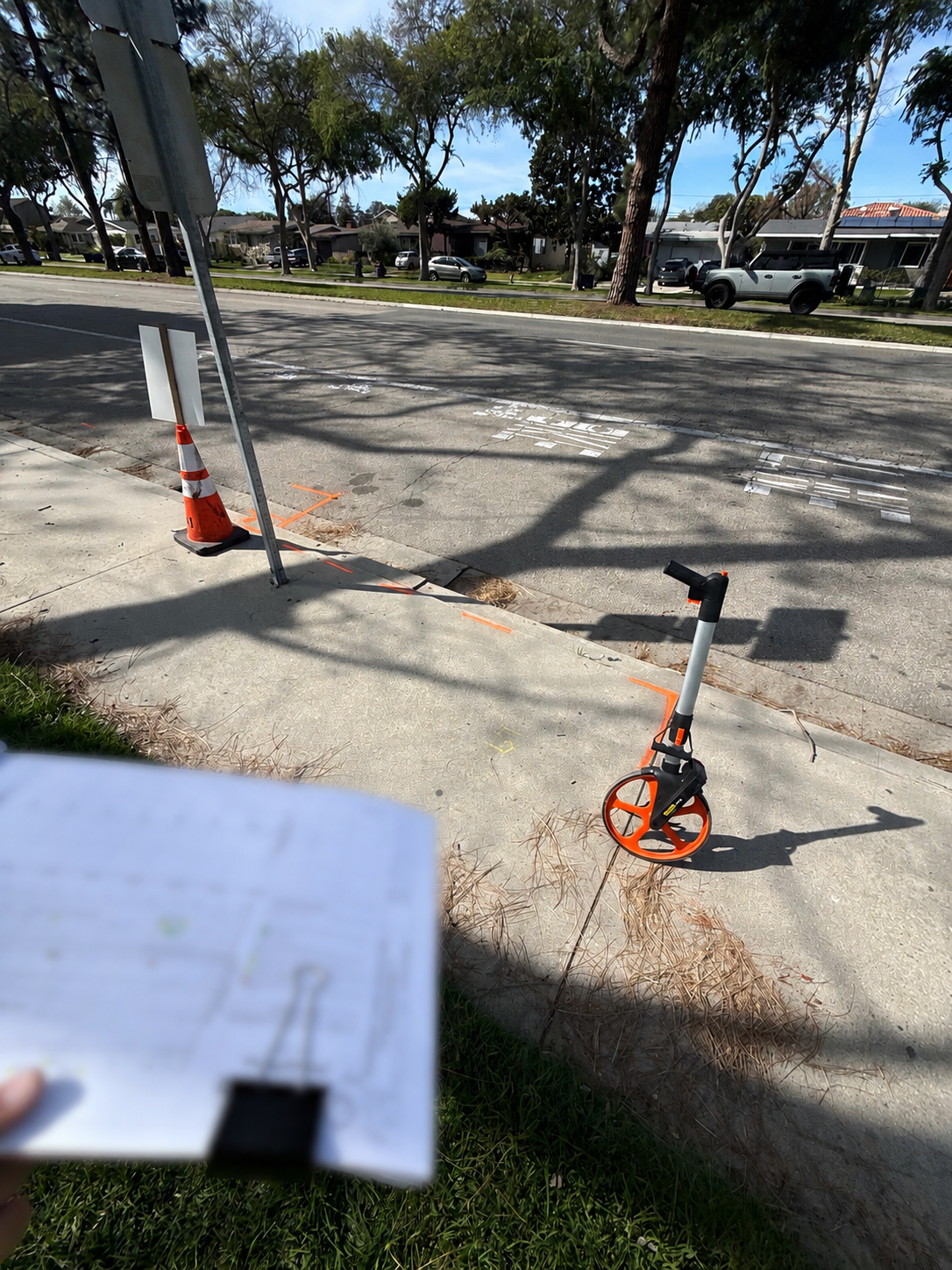
- Linear measurements are taken with a tape, a surveyor's wheel, or a GPS rover recording the start and end coordinates of an installed run.
- On pipe projects, the measurement is taken from center of structure to center of structure, not from the end of pipe to end of pipe.
Area measurements
Area measurements capture two-dimensional coverage. The unit depends on the work type and the contract.
- Units: Square yard (SY), square foot (SF), acre (AC)
- Examples: Asphalt paving (SY), concrete flatwork (SF), seeding and hydroseeding (AC or SF), waterproofing membrane (SF), traffic lane striping (SF)
- Paving quantities are almost always measured in square yards in heavy civil and public works contracts. Building construction more commonly uses square feet. Know what the contract requires before logging quantities.
- Area is calculated as length times width. For irregular shapes, break the area into rectangles or triangles and sum the parts.
Volume measurements and earthwork factors
Volume is measured in cubic yards (CY) in US construction. Earthwork has three distinct states that produce three different volumes from the same material.
Bank cubic yards (BCY)
Material in its natural, undisturbed state in the ground. Most earthwork contracts pay on bank cubic yards because it is the most stable measurement.
Loose cubic yards (LCY)
Material after excavation and loading into trucks. Volume increases because of voids between particles. Typical swell for common earth is 15% to 25%.
Compacted cubic yards (CCY)
Material after placement and compaction. Volume decreases from the loose state. Typical shrinkage for common earth is 10% to 15%.
The conversion between bank, loose, and compacted requires swell and shrinkage factors specific to the soil type. Sandy soils and rock behave very differently. Earthwork quantity disputes often come down to which measure and which conversion factor was used.
Weight measurements and the ton problem
Weight is used for materials where density varies or where material is purchased by weight at a certified scale.
- Examples: Asphalt (TON), aggregate base (TON), rip rap (TON), steel reinforcement (LB or TON)
- Short ton (US ton): 2,000 pounds. Standard in most US construction contracts.
- Metric ton (tonne): 2,204.6 pounds. Used on some international and federal contracts.
- Long ton: 2,240 pounds. British imperial unit still used in some marine, dredging, and harbor construction contracts on federally funded coastal work. A 12% difference from a short ton that can meaningfully affect billing if assumed incorrectly.
- Scale tickets from a certified scale are the measurement document for weight-based pay items. Keep every scale ticket. They are the primary evidence in a quantity dispute.
Station-based measurements on linear projects
Road, pipeline, and utility projects use station-and-offset notation to locate work along a corridor.
- One station equals 100 feet measured along the project baseline.
- Station 22+50 means 2,250 feet from the project origin (Station 0+00).
- Offset describes distance and direction from the centerline: "14 LF right of centerline" means 14 feet to the right of the baseline when looking in the direction of increasing stations.
- Field measurement logs on road projects should reference station and offset so quantities can be tied to specific plan sheets and cross-sections.
How field measurements are taken and verified
Tape measure and surveyor's wheel
Traditional tools for linear measurements in the field. Fast and accurate enough for most pipe, curb, and fencing quantities.
Total station and surveyor's rod
Used for precision measurements on grade-sensitive work. Cross-sections, structure locations, and as-built surveys.
GPS rover
Records x/y/z coordinates in real time. Used for quantity takeoffs, as-built verification, and grading acceptance. Data ties directly to the project coordinate system.
Drone photogrammetry
Aerial scanning that generates a surface model of the site. Compared against the pre-construction survey to calculate earthwork volumes across large areas. Increasingly common on projects over $5 million in earthwork scope.
Certified scale tickets
For material paid by weight, every truck is weighed at a certified scale. The scale ticket is the measurement document. No ticket means no billing backup.
Cross-section method for earthwork
A surveyor takes cross-sections at regular intervals along the corridor. Software calculates the volume between adjacent cross-sections by averaging the end areas. This is the standard method for mass earthwork verification on public agency contracts.
Measurement documentation on a project
The most common reason contractors lose billing disputes is documentation that was not created at the time of the work.
- Daily quantities should be logged at the time of placement, not reconstructed at the end of the billing period.
- Scale tickets, delivery receipts, and inspector quantity reports are primary source documents. Keep the originals.
- Disputes are almost always won or lost based on contemporaneous documentation: records written at the time, not after the fact.
- Most public agency contracts require the resident engineer or inspector to sign off on quantities before they can be included in a pay application. Get that signature before the crew leaves the area.
- Field measurement logs tied to a specific date, location, and inspector name carry far more weight than a PM's spreadsheet reconstructed at billing time.
Quantities logged at the map location where the work happened
HeavyCivilHelper lets field crews log quantities directly on the map at the location where the work was done. Each entry is timestamped and GPS-located, so the documentation is already tied to a map pin when the pay application is due.
Common questions about field measurements
- What are field measurements in construction?
- Field measurements are the physical quantities recorded in the field to document how much work has been completed or how much material has been placed. They are the primary evidence behind every progress billing line item on a construction contract. Without contemporaneous field measurement records, billing claims are difficult to defend and easy to dispute.
- What is the difference between a short ton, metric ton, and long ton?
- A short ton is 2,000 pounds, the standard unit in most US construction contracts. A metric ton (also called a tonne) is 2,204.6 pounds. A long ton is 2,240 pounds and is a British imperial unit still used in some marine, dredging, and harbor construction contracts on federally funded coastal work. The 12% difference between a short ton and a long ton can meaningfully affect billing if the wrong unit is assumed. Always confirm which ton the contract uses.
- What is the difference between bank, loose, and compacted cubic yards?
- Bank cubic yards (BCY) measure material in its natural, undisturbed state. Loose cubic yards (LCY) measure material after excavation, when it has expanded due to voids. Compacted cubic yards (CCY) measure material after it has been placed and compacted, which reduces volume. Most contracts pay for earthwork in bank cubic yards. Swell and shrinkage factors need to be applied correctly when converting between the three for cost and billing purposes.
- Why does the unit of measurement matter in a construction contract?
- The contract unit price is tied to a specific unit. If a paving contract pays $18.50 per square yard and the contractor measures in square feet, they will underbill by a factor of nine. Unit confusion is most common on contracts that mix SI and imperial units, or on dredging contracts that use long tons instead of short tons. Confirm the measurement unit for every pay item before the first billing cycle.
- What is a station in construction survey measurements?
- A station is a point along a linear project measured from a defined origin. One station equals 100 feet. Station 22+50 means 2,250 feet from the project origin. Offset describes how far left or right of the centerline a point is located. Field measurements on road, pipeline, and utility projects are often tied to station and offset so the work can be located precisely on the plan sheets.
- How are earthwork quantities verified?
- Earthwork quantities are typically verified by cross-section survey. A surveyor takes cross-sections at set intervals along the corridor; software calculates volume by averaging end areas between adjacent cross-sections. For large earthwork operations, drone photogrammetry is increasingly used to generate surface models that are compared against the pre-construction survey. Load counts with certified scale tickets are used for material paid by weight.
- How does HeavyCivilHelper help with field quantity tracking?
- HeavyCivilHelper lets field crews log quantities directly at the map location where the work was done. Each entry is timestamped. When the pay application is due, the quantity records are already organized by work area on the map rather than scattered across daily reports and emails. The location tie also makes it easier to verify quantities against the plan when an owner or inspector challenges a billing claim.
Related topics
Construction Accounting
How field quantities connect to progress billing, job costing, and pay applications.
Schedule of Values
The SOV line items that field measurements back up at billing time.
T&M in Construction
How extra work quantities are documented and billed outside the base contract.
Construction Survey
GPS rovers, total stations, and cross-section methods used for quantity verification.