T&M ticket structure
Date
Required
Location / Station
Required
Description of extra work
Must reference the directive, RFI, or condition that created the extra work
Labor
Equipment
Materials
Contractor Representative
Signature: ______________________
Owner's Rep / Inspector Signature
Get this signed before leaving the site
Signature: ______________________
When T&M applies
Extra work ordered by the owner or agency
Work that is clearly outside the original contract scope and is directed in writing or verbally by the owner's representative. A written directive is preferable to a verbal direction. If the direction is verbal, confirm it in writing the same day.
Differing site conditions
Unforeseen conditions that change the method or amount of work: rock where the plans showed soil, utilities that weren't on the as-builts, abandoned structures, contaminated material. Most contracts have a differing site conditions clause that entitles the contractor to additional compensation when conditions differ materially from what the plans represented.
Emergency work directed in the field
An inspector or owner's representative directs work that needs to start immediately before a formal change order can be negotiated. The T&M ticket documents what happened until the formal CO catches up.
Work on a directive before a change order is negotiated
A field directive orders the contractor to proceed with extra work before the price is agreed. The contractor starts work, records everything on T&M tickets, and uses those records to price the formal change order afterward.
Directive vs RCO explainedForce account work on public agency projects
Federal and state DOT contracts use the term force account instead of T&M. The documentation requirements are more specific: daily force account records signed by the inspector, equipment logs, and material invoices. On federally funded projects, labor and equipment rates may be set by FHWA standard rate tables.
What goes on a T&M ticket
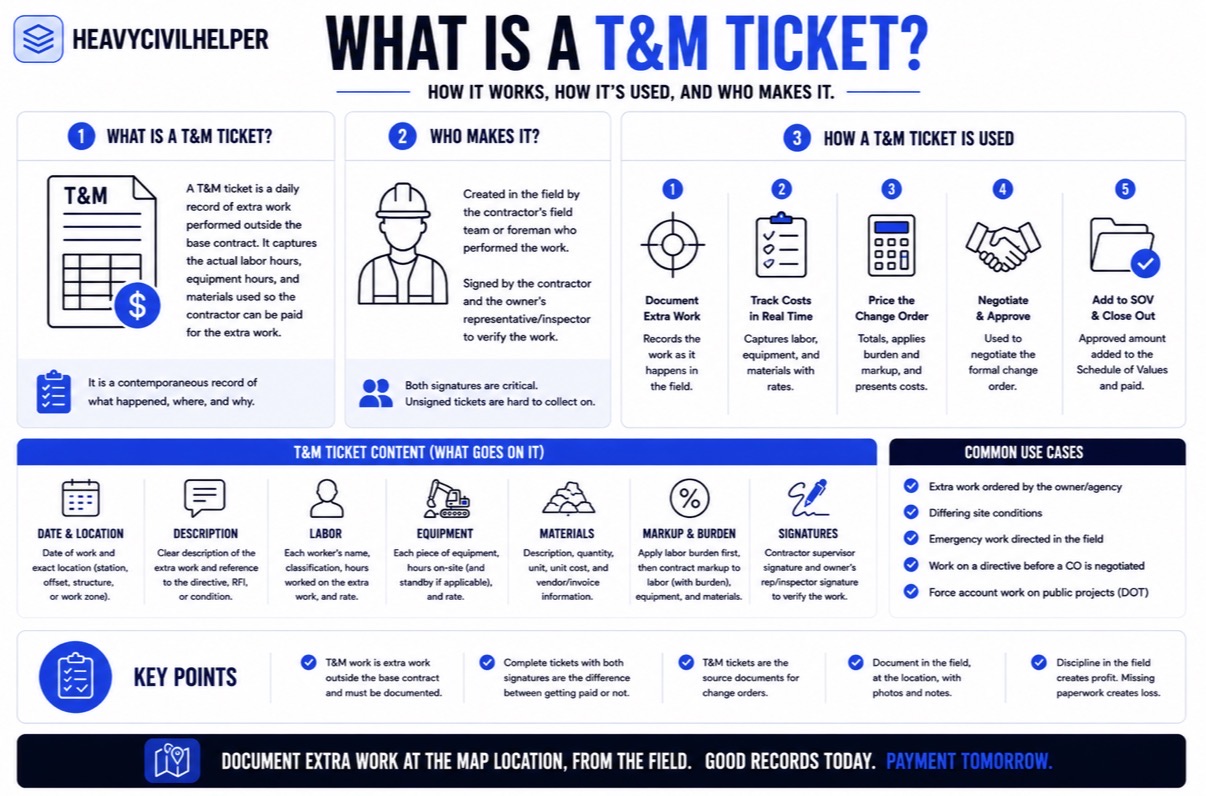
A T&M ticket is a contemporaneous record of what happened on a specific day at a specific location. Missing fields give owners grounds to reduce or reject payment.
Date and location
The date the work was performed and the specific location on the project: station and offset, structure number, or work zone. This ties the ticket to the right area of the plans.
Description of the extra work
A clear description that references the directive, RFI, or condition that created the extra work. 'Excavated utility conflict at Sta 22+50 per RE direction 6/15' is useful. 'Extra excavation' is not.
Labor table
Each worker's full name, classification (Laborer, Equipment Operator, Foreman, etc.), hours on the extra work, and the applicable wage rate. Workers who split time between base contract work and T&M work on the same day need separate time entries.
Equipment table
Each piece of equipment used, the hours on-site (and standby hours if applicable), and the rate. Equipment rates come from the contract, from rental invoices, or from recognized rate guides such as the Blue Book.
Materials table
Material description, quantity, unit, unit cost, and the vendor or invoice number. Delivery receipts and scale tickets are the supporting documents.
Markup
Labor burden is applied first, then the contractor's markup percentage as specified in the contract. Markup is applied to labor including burden, equipment, and materials. Subcontractor T&M work carries a smaller prime markup, typically 5% to 10%.
Signatures
The contractor's supervisor or foreman signs to certify the records are accurate. The owner's representative or inspector signs to acknowledge the work and quantities. An unsigned ticket is extremely difficult to collect on.
T&M markup rates and contract language
The allowable markup on T&M work is specified in the contract. Know the rates before T&M work starts, not at billing time.
- Common markup range: 15% to 25% on labor (including burden), equipment, and materials. The contract controls; negotiate the markup rate at contract execution if possible.
- Labor burden covers payroll taxes, workers' compensation, health insurance, and retirement contributions. Burden typically runs 30% to 50% of the base straight-time wage.
- Equipment rates come from rental invoices, the contractor's ownership cost records, or recognized rate guides. The Blue Book (Rental Rate Blue Book for Construction Equipment) and FHWA equipment rate schedules are commonly cited on public work.
- Subcontractor T&M markup: the prime contractor is typically allowed 5% to 10% on a sub's T&M work, on top of whatever markup the sub is applying.
- Overtime premiums, if applicable, are separately identified and may have different markup rules under the contract.
Common T&M disputes and how to avoid them
Unsigned tickets
The owner's representative refuses to pay because there is no signature to confirm the work happened or the hours are accurate. Get signatures at the end of each workday. A note saying 'signature requested, declined by RE' is better than a blank signature line.
Equipment not logged
A piece of equipment was on-site and used on the extra work but not recorded on the T&M ticket. Equipment that is not on the ticket at the time of the work is almost impossible to add later without dispute. Log everything that moved dirt or lifted materials that day.
Rate disputes
The owner challenges the labor or equipment rates applied. Rental invoices, certified payroll records, and pre-agreed rate schedules in the contract are the documentation that resolves this.
Scope disputes
The owner claims the work was included in the base contract scope. The field description on the ticket needs to clearly tie the work to the event or directive that created it. A reference to the RE's verbal direction, a specific RFI, or a specific differing condition is what distinguishes T&M work from base contract work in a dispute.
How T&M tickets connect to change orders
T&M tickets are the source documents for pricing a change order when extra work is performed before the price is agreed.
- After the extra work is complete, compile all T&M tickets for that scope, total the labor, equipment, and material costs, apply burden and markup, and present the total to negotiate the formal change order.
- Some owners accept the T&M total directly as the payment basis. Others treat it as a ceiling and negotiate down from there. In either case, complete signed tickets are what makes the conversation possible.
- Change orders that originate from T&M work are added to the Schedule of Values as new line items before the next billing cycle.
- T&M tickets for force account work on public contracts typically need to be submitted to the resident engineer within a specified number of days after the work is performed. Check the contract for that deadline.
Video overview
Extra work documented at the map location, from the field
When an inspector directs extra work in the field, HeavyCivilHelper lets the foreman create a record at the map location, log the work description, and attach photos on the spot. The documentation exists from day one, not when billing starts.
Common questions about T&M in construction
- What does T&M mean in construction?
- T&M stands for Time and Materials. It is a billing method used for extra work that falls outside the base contract. Instead of a fixed unit price or lump sum, T&M work is billed based on the actual labor hours, equipment hours, and materials used. Most construction contracts include a clause specifying how T&M work must be documented and approved.
- What is force account work?
- Force account is the public agency equivalent of T&M. The term is used in federal and state DOT contracts. Force account work follows specific documentation requirements set by FHWA and state transportation agencies: daily force account records signed by the inspector, equipment logs, and material invoices. On federally funded projects, labor and equipment rates are often set by FHWA tables rather than market rates.
- What has to be on a T&M ticket?
- A complete T&M ticket needs the date, location, and a description of the extra work that connects it to the directive or event that created it. It needs a labor table with each worker's name, classification, hours, and rate. It needs an equipment table with each piece of equipment, hours on-site, and rate. It needs a materials table with description, quantity, unit, unit cost, and vendor. And it needs signature lines for the contractor's supervisor and the owner's representative or inspector.
- What happens if a T&M ticket is not signed?
- An unsigned T&M ticket is extremely difficult to collect on. The owner's representative can argue they never authorized the work, never agreed the hours were accurate, or that the work was included in the base contract. Best practice is to get the inspector or owner's rep to sign at the end of each workday, not at billing time. Some owners will sign to acknowledge the work was performed without agreeing to the cost; that notation is still better than no signature.
- What markup is allowed on T&M work?
- The allowable markup percentage is specified in the contract. Common ranges are 15% to 25% on labor, equipment, and materials. Labor burden, which covers payroll taxes, workers' compensation, health insurance, and retirement contributions, is typically added on top of the straight-time wage rate before the markup is applied. Burden commonly runs 30% to 50% of the base wage. On subcontractor T&M work, the prime contractor is usually allowed a smaller markup, often 5% to 10%.
- What is the difference between T&M and a lump sum change order?
- T&M records what actually happened: the real labor hours, equipment hours, and materials used, plus the contractually allowed markup. A lump sum change order is a negotiated fixed price agreed to before the work starts. T&M is used when the scope is unknown or when the owner directs work to proceed before a price can be negotiated. The T&M records then become the basis for pricing the formal change order after the fact.
- How do T&M tickets become a change order?
- After the extra work is complete, the PM compiles all T&M tickets for that scope of work, totals the labor, equipment, and material costs, applies the allowed burden and markup, and uses that total to negotiate the formal change order price. Some owners accept T&M totals directly as the payment amount. Others use them as a ceiling or starting point for negotiation. Either way, having complete signed T&M tickets is what makes the negotiation possible.
- How does HeavyCivilHelper support T&M documentation?
- When an inspector directs extra work in the field, the foreman can create a record at the map location, log the work description, and attach photos on the spot. That record is timestamped and GPS-located from the moment it is created. By the time billing starts, the documentation already exists at the right location on the map rather than being reconstructed from memory or from notes on a clipboard that may no longer be legible.
Related topics
Construction Accounting
How T&M billing fits into the broader billing and job costing workflow on a project.
Schedule of Values
How T&M change orders get added to the SOV and billed on future pay applications.
Field Measurements
How quantities are documented in the field as evidence for billing claims.
Directive vs RCO
How field directives create T&M work and how RCOs formalize the cost.
Change Orders
How T&M tickets become the basis for a formal change order.