What you get
What goes on a punch list
Incomplete work, items that do not match the specs, damaged work that needs repair, missing fixtures or finishes, and any work that was substituted without approval. Each item is a discrete task with a location, a responsible party, and a deadline.
Who conducts the punch walk
The owner, architect, or owner's representative walks the project and documents deficiencies. On public works, the agency inspector or PM conducts the walk. The GC accompanies them and notes each item.
How resolution works
The GC distributes punch list items to the relevant subcontractors. Each sub corrects their items and notifies the GC. The GC verifies the work and requests a re-walk from the owner or architect to confirm each item is closed.
What completion means
Substantial completion allows the owner to occupy or use the project. Final completion means all punch list items are resolved. Retainage — often 5-10% of the contract value — is typically held until final completion.
The difference between substantial and final completion
Substantial completion is when the project is usable for its intended purpose, even if minor items remain outstanding. Final completion is when the last punch list item is signed off. Both dates trigger contractual obligations — warranty periods, retainage release, and insurance requirements.
Why not spreadsheets, sticky notes, or memory?
- A punch list in a spreadsheet cannot show the inspector which deficiencies are in the north stairwell vs the south wing — the location context is gone.
- When a sub marks an item 'done' in their copy of the spreadsheet, the GC's copy is still showing it open — there is no shared live status.
- Photos attached to a spreadsheet row do not stay associated with the location of the deficiency.
- The owner cannot verify what is open and what is closed without someone emailing them an updated copy.
How the punch list process works
The punch list process starts when the GC notifies the owner that the project is ready for the final walk. The owner or architect inspects the completed work and documents any item that does not meet the contract requirements. That list is the punch list.
Each punch list item typically includes:
- A description of the deficiency or incomplete item
- The location in the project (room number, floor, zone, or station)
- The specification section or contract requirement it references
- The party responsible for correcting it (GC, specific subcontractor)
- A completion deadline
The GC distributes the list to the relevant subs, tracks completion, and requests a re-walk from the owner to confirm each item is resolved. On large projects this process can take weeks.
Punch list vs RFI vs directive: knowing the difference
Punch list
A closeout document created near project completion listing deficiencies, incomplete work, and non-conforming items that must be corrected before final payment. Generated by the owner or architect during a final walk.
RFI (Request for Information)
A formal question the contractor submits to the designer or owner during construction — about a plan conflict, a changed condition, or a specification ambiguity. RFIs happen during active construction, not at closeout.
Directive
An instruction to proceed under changed conditions, typically issued by the owner or engineer during construction. A directive can trigger a change order. It is not a closeout document.
Change order
A formal contract modification that changes the scope, cost, or schedule. Change orders can arise from RFIs or directives but are different documents with their own approval process.
Using HeavyCivilHelper as a digital punch list
HeavyCivilHelper's custom pin system can be configured to function as a GPS-based punch list for any project type. During the punch walk, drop a pin at each deficiency location, set the category to the type of item (concrete finish, painting, fixture, caulking), and set status to Open. As items are resolved, the sub updates status to Closed on their phone.
The map view gives the GC a geographic layout of all outstanding items. The owner or architect can access the same map on their device during the re-walk and verify completion at each location without a separate sign-off form. No email chain needed to confirm what is open and what is done.
- Drop a pin at each deficiency location during the walk
- Custom categories for item type: concrete, painting, mechanical, electrical, site
- Attach photos of the deficiency at the pin location
- Status updates from Open to In Progress to Closed as work is completed
- The owner verifies closure at each GPS location during the re-walk
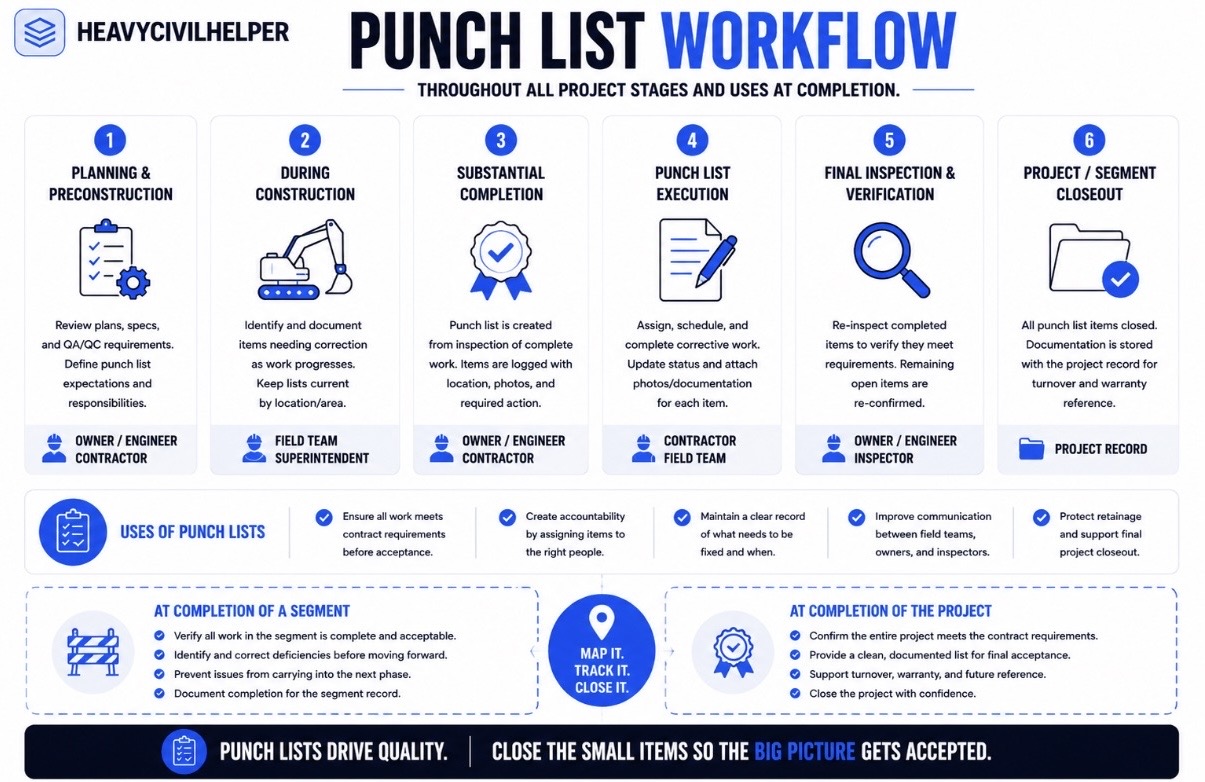
Punch list workflow overview
From planning and preconstruction through final project closeout — a quick look at how punch lists are used at every stage of a heavy civil project.
Punch list workflow — all project stages
The six stages of a punch list — from initial planning through project closeout — and how accountability flows between owners, field teams, contractors, and inspectors.
Frequently asked questions about punch lists
- What is a punch list in construction?
- A punch list is a document generated at or near project completion that records outstanding deficiencies, incomplete items, and work that does not conform to the contract. The owner or architect walks the project and 'punches' each item that needs to be corrected before final payment is released. Once all punch list items are resolved and signed off, the project achieves substantial completion and final payment is processed.
- Who creates a punch list?
- The punch list is typically created by the owner, architect, or owner's representative during a final walk of the project. On public works projects, the agency inspector or project manager conducts the walk. The GC and relevant subcontractors then receive the list and are responsible for completing each item within a specified timeframe. In practice, GCs often do their own pre-punch walk before the owner's walk to resolve obvious items first.
- What is the difference between a punch list and a snag list?
- A punch list and a snag list are the same thing — 'punch list' is the American English term, 'snag list' is used in the UK and Australia. Both refer to the same closeout process: documenting outstanding deficiencies near project completion and tracking them until they are resolved and accepted by the owner.
- How is a punch list different from an RFI or directive?
- An RFI (Request for Information) is a question the contractor asks the designer or owner during construction — typically about a plan conflict, a changed condition, or a clarification needed before proceeding. A directive is an instruction to proceed under changed conditions, often with cost implications. A punch list is a closeout document: it records work that was done incorrectly or left incomplete at the end of the project. RFIs and directives happen during construction; punch lists happen at the end.
- Can HeavyCivilHelper serve as a digital punch list?
- Yes. HeavyCivilHelper's custom pin system can be configured to function as a digital punch list: drop a pin at each deficiency location, set status to Open, and update it to Closed when the item is resolved. Custom categories can match the type of punch item — concrete finish, painting, caulking, fixture installation. The map interface gives the GC a geographic view of all outstanding items across the project, and the inspector can verify completion at each location on their phone during the acceptance walk.
- What happens after the punch list is complete?
- When all punch list items are resolved and the owner signs off, the project achieves final completion. The GC submits the final pay application, retainage is released, and the warranty period begins. Some contracts have a separate 'substantial completion' date (when the owner can occupy or use the project) and a 'final completion' date (when all punch list items are resolved). The distinction matters for retainage and warranty period start dates.
See it on a real map
The interactive demo loads sample data so you can click through it in under a minute.
Related
Custom Pin Categories
How to configure HeavyCivilHelper's custom pin categories as a GPS-based punch list for any project type.
What Is an RFI in Construction?
How RFIs work during construction — different from punch list items but often related.
What Is a Construction Change Order?
How change orders work, and how they differ from punch list corrections.
Directive vs RCO in Construction
Field directives vs requests for change orders — important context for any punch list conversation.
Public Works and Heavy Civil
How HCH handles inspection holds, punch items, and closeout documentation on public works projects.